

일본이 조선의 뿌리 역사를 제거하기 위해 만든 기관인 조선사편수회에서 조선사 왜곡에 그 누구보다 앞장선 사람은 이마니시 류입니다. [조선사] 편찬의 중심인물이기도 한 이마니시는 일제가 강탈한 조선사 문헌을 총체적으로 연구한 끝에 조선의 시원 역사를 말살할 결정적 작품을 만들었습니다.
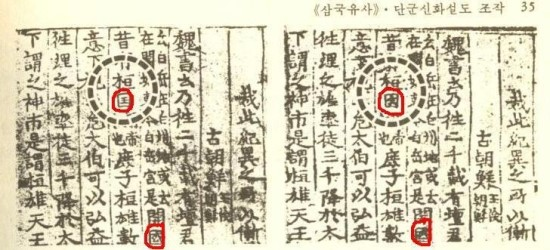
다름 아니라 [삼국유사] <고조선기>에 나오는 석유환국을 석유환인으로 뜯어고친 것입니다. 이로써 ‘옛적에 환국이 있었다’는 인류 창세사의 건국 이야기를 ‘옛적에 환인이 있었다(昔有桓因)’로 바꾸어 버렸다. 국(國)을 인(因)으로 글자 하나를 변조함으로써 한민족 상고사의 첫 나라인 환국을 통째로 지워 버린 것입니다. 이마니시 류는 석유환국의 국자를 깨뜨림으로써 환국에서 뻗어 나간 배달과 고조선도 잘라내는 일거양득의 효과를 얻게 되었습니다.
환국의 역사를 부정하면서, 마지막 환인천제로부터 천명을 받아 백두산에서 동방 한민족사를 처음 개척한 환웅도 신화의 인물로, 환웅의 신시개천을 계승한 고조선의 건국자 단군도 허구의 인물로 부정해 버린 것입니다. 이로써 한민족의 7천 년 상고사가 송두리째 뿌리 뽑혀 버렸다.
이마니시가 활동하던 당시 일본이 수거한 20여 만 권의 조선 서적 중에는 계연수가 편찬한 [환단고기] 초간본도 포함되어 있었을 것입니다. 이 책을 검토한 이마니시는 조선의 장구한 고대사에 크나큰 충격을 받고, 환국-배달-고조선을 말살할 방법을 모색하게 되었습니다. 그 후 십여 년(1911~1026)의 연구 끝에 환단의 역사를 한꺼번에 말살할 수 있는 회심작으로 마침내 석유환인을 만들어 낸 것입니다.
그렇다면 이마니시는 무엇을 근거로 석유환인을 주장한 것일까? 그 답을 그의 논문 檀君考에서 찾아볼 수 있습니다.
“환인의 인자는 간본 문자가 와왜(訛歪)되어 국자에 가깝기 때문에 동경대학 간본에서는 환국이라고 하고 있어서 이 또한 일부 사람들이 이용하고 있다. 단군전설에 있는 제석천환인을 제거시키고 환국이 바르다 칭하고 있는 것이다. 제석이라는 주에 의하면 이를 환국으로 개정할 수 없다.“
이와 같이 이마니시는 1904년 동경대에서 인쇄한 삼국유사에 적힌 석유환국을 잘못된 기록으로 부정하고, 일연이 그 구절에 붙인 “제석을 이른다”라는 주석에 따라 석유환국을 석유환인으로 해야 한다고 주장한 것입니다. 제석은 제석천환인의 줄임말로 인드라라는 인도 신령을 일컫습니다.
이마니시는 승려 일연이 환국의 환인천제를 불교의 신, 환인과 동일시한 것을 이용하여 환국의 신화의 역사로 전락시켰습니다. 일연을 내세워 한민족 시원 역사 부정의 근거를 세운 것입니다. 이마니시는 석유환인이라 새겨진 삼국유사 경도제대 영인본을 1926년에 세상에 출시하였습니다. 모교인 동경대에서 펴낸 삼국유사에 석유환국으로 표기된 것이 이마니시에게 큰 부담이었기 때문에 아예 원본을 고쳐 그 영인본을 배포한 것입니다.
일본에서는 일찍이 일본서기를 지어 1,300년의 자국 역사를 2,600년으로 늘렸지만 조선 역사는 여전히 일본보다 장구하였습니다. 하지만 이마니시가 환국-배달-고조선의 삼성조 역사를 신화로 만들어 버림으로써 조선 역사는 불과 2,000으로 대폭 축소되는 결과를 낳게 되었습니다. 석유환인에 대한 역사적 진실을 밝혀 주는 유일한 사서가 바로 환단고기입니다.
삼성기 하에 적혀 있는 석유환국뿐 아니라 삼성기상의 오환건국이 최고라는 기록이 그 진실을 말하고 있습니다. 학계에서는 앞으로 환국을 심층적으로 연구하여 환국 역사의 진실을 제대로 밝혀야 할 것입니다.

———————–
Among those most actively involved in distorting Korean history under the Joseon History Compilation Committee—a Japanese imperial institution created to erase the roots of Joseon’s history—was Imanishi Ryū. As the central figure in compiling the Joseon History, Imanishi conducted comprehensive research on historical texts looted by Imperial Japan and produced a decisive work aimed at obliterating the foundational history of Korea.
This was none other than altering Seok-Yu-Hwan-Guk (昔有桓國), found in the Samguk Yusa’s “Gojoseon Section,” to Seok-Yu-Hwan-In (昔有桓因). With this change, the origin story of human civilization, originally recorded as “Long ago, there was Hwan-guk,” was distorted into “Long ago, there was Hwan-in.” By altering a single character—from “Guk (國)” meaning nation, to “In (因)”—he effectively erased Hwan-guk, the first nation in ancient Korean history. By destroying the character “Guk,” Imanishi not only eliminated Hwan-guk but also severed its extensions—Baedal-guk and Gojoseon—in a single blow.
By denying the history of Hwan-guk, Imanishi relegated Hwan-ung—who, under divine mandate from the last heavenly emperor Hwan-in, pioneered Korean history in the East from Mount Baekdu—to the realm of myth. Likewise, Dangun, the founder of Gojoseon who succeeded Hwan-ung’s Shinshi Gaechon (the divine founding of Shinshi), was also dismissed as a fictional character. In this way, the 7,000-year-long ancient history of the Korean people was completely uprooted.
At the time Imanishi was active, among the approximately 200,000 Korean books confiscated by the Japanese, the first edition of Hwandan Gogi, compiled by Gye Yeon-su, was likely included. Upon reviewing this text, Imanishi, shocked by Korea’s lengthy ancient history, began searching for a way to erase the historical continuum of Hwan-guk, Baedal-guk, and Gojoseon. After more than a decade of research (1911–1926), he finally crafted his magnum opus—the fabrication of Seok-Yu-Hwan-In—to simultaneously annihilate the entire history of Hwandan.
What, then, was Imanishi’s basis for advocating Seok-Yu-Hwan-In? The answer lies in his paper Dangun-Ko (A Study on Dangun).
“The character ‘In (因)’ in Hwan-in is a distorted form close to ‘Guk (國)’ due to copyist error. Therefore, in the Tokyo University edition, it is written as Hwan-guk, and some people use that. They claim Hwan-guk is correct by removing Hwan-in of the celestial deity from the Dangun legend. But if the annotation refers to Je-seok, it cannot be revised to Hwan-guk.”
Thus, Imanishi rejected Seok-Yu-Hwan-Guk written in the 1904 Tokyo University-printed Samguk Yusa as a mistake. Instead, based on the annotation “refers to Je-seok” added by the monk Ilyeon, he argued that the correct expression should be Seok-Yu-Hwan-In. Je-seok is an abbreviation of Je-seok-cheon-Hwan-in, referring to the Indian deity Indra.
Imanishi exploited monk Ilyeon’s conflation of the heavenly emperor Hwan-in of Hwan-guk with the Buddhist deity Hwan-in to downgrade the historical narrative of Hwan-guk into myth. By foregrounding Ilyeon, he constructed a rationale to deny the origins of Korean history. In 1926, Imanishi published the Samguk Yusa Gyeongdo Imperial University facsimile edition containing the altered Seok-Yu-Hwan-In. Since the Samguk Yusa edition previously printed by his alma mater Tokyo University had used Seok-Yu-Hwan-Guk, this discrepancy weighed heavily on him—thus he simply edited the original and distributed the revised edition.
In contrast to Japan, which extended its own history to 2,600 years by compiling the Nihon Shoki, Korea’s history still outstripped Japan’s in length. But with Imanishi’s transformation of the triad of Hwan-guk, Baedal-guk, and Gojoseon into myth, Korea’s historical timeline was dramatically reduced to just 2,000 years. The only extant historical record that reveals the truth about Seok-Yu-Hwan-In is the Hwandan Gogi.
In addition to the Seok-Yu-Hwan-Guk recorded in Samseong-gi Ha, the note “The founding of Oh-Hwan is the greatest” in Samseong-gi Sang testifies to this historical truth. The academic community must henceforth conduct in-depth research on Hwan-guk to properly uncover the truth of its history.