

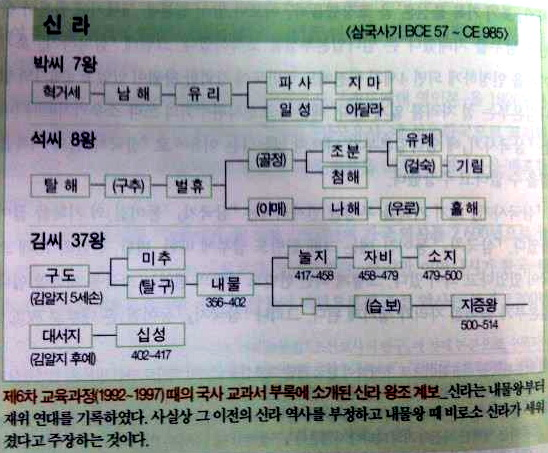
일본은 환국, 배달, 고조선뿐 아니라 고구려, 백제, 신라의 삼국시대 역사도 축소하였습니다. 삼국사기에 따르면 신라는 BCE57년, 고구려는 BCE37년, 백제는 BCE18년에 건국되었습니다. 그런데 일본은 삼국사기의 상대 기록을 역사적 사실로 인정하지 않을 뿐만 아니라 삼국시대 초기 왕들의 존재도 부정하였습니다. 삼국의 초기 왕을 모두 누락시키고 고구려는 6세 태조왕, 백제는 8세 고이왕, 신라는 17세 내물왕부터 그 이름을 거론하였습니다.
일본은 삼국사기에 기록을 인정하게 되면 4세기 이전에도 한반도에 강력한 왕권이 있었고 4세기의 임나일본부는 설 자리를 잃게 됩니다. 때문에 조선사편수회의 쓰다 소우키치는 삼국사기에 임나일본부가 나오지 않는 다는 이유로 삼국사기의 기록을 믿을 수 없다고 주장했습니다. 삼국사기 초기 기록을 부정한 빈자리에는 삼국지-동이전의 기록을 끌어 들였습니다.
삼국지-동이전에는 그때 한반도 남부에 마한, 변한, 진한의 78개 소국이 있었다고 되어 있습니다. 그렇게 되면 한반도 남부의 힘없는 소국을 지배할 임나일본부가 들어설 자리가 생기됩니다. 그러나 삼국지-동이전은 대부분 BCE2세기 때의 역사를 기록한 책이고, 그 저자인 진수가 부정확한 사료와 전해들은 이야기를 바탕으로 기록하였으므로 신빙성이 떨어지는 사료라는 것이 학계의 정설입니다.
그런데 삼국사기 초기 기록 불신론이 야기한 더욱 심각한 문제가 있습니다. 그것은 일제가 심어 놓은 이 낭설이 한국의 주류 사학계에 그대로 관철되고 있다는 것입니다. 제6차 교육과정까지의 국사 교과서는 부록 ‘역대 왕조 계보’에서 삼국 초기 국왕들의 재위 연대를 적지 않았습니다. 고구려는 6세 태조왕부터 재위 연대를 기록했고, 백제는 8세 고이왕부터, 신라는 제 17세 내물왕부터 재위 연대를 기록하였습니다.
제 7차 교육과정부터는 각 왕조의 1세 왕부터 연대가 기록되었는데, 이것도 역사 학자들이 인정해서 기록한 것이 아니라 한일역사공동연구회에 참여한 교육부 관료들이 강력히 주장하여 마지못해 넣은 것입니다. 그러나 본문에서는 여전히 초기 왕들의 행적이 서술되지 않아 사실상 삼국 시대 초기 역사는 지금도 계속하여 부정당하고 있는 것이 우리의 현실입니다.

———————
Japan not only diminished the histories of Hwan-guk, Baedal, and Gojoseon but also deliberately downplayed the historical narratives of the Three Kingdoms era—Goguryeo, Baekje, and Silla. According to the Samguk Sagi, Silla was founded in 57 BCE, Goguryeo in 37 BCE, and Baekje in 18 BCE.
However, Japan not only refused to acknowledge the early records in the Samguk Sagi as historical facts but also denied the very existence of the early monarchs of the Three Kingdoms. Japan omitted the founding kings entirely and only began to reference Goguryeo from its sixth monarch, King Taejo; Baekje from its eighth monarch, King Goi; and Silla from its seventeenth monarch, King Naemul.
Japan’s refusal to recognize the Samguk Sagi stems from the implication that acknowledging its records would confirm the existence of powerful monarchies on the Korean Peninsula prior to the fourth century. Such recognition would nullify the historical plausibility of the Mimana Nihonfu (任那日本府), the Japanese outpost theory in the Korean peninsula.
As a result, Tsuda Sōkichi of the Joseon History Compilation Committee argued that the Samguk Sagi could not be trusted, precisely because it made no mention of the Mimana Nihonfu. To fill the historical vacuum created by dismissing the early records of the Samguk Sagi, Japan resorted to the accounts in the Records of the Three Kingdoms (Sanguozhi)—specifically, the “Accounts of the Eastern Barbarians” (Dongyi Zhuan).
According to the Dongyi Zhuan, 78 small polities known as Mahan, Byeonhan, and Jinhan existed in the southern part of the Korean Peninsula. This narrative conveniently provides the context for Japanese control over a fragmented and weak southern Korea through the Mimana Nihonfu. However, the Dongyi Zhuan mainly documents events from the 2nd century BCE and was compiled by Chen Shou based on hearsay and unreliable sources. Therefore, mainstream academic consensus regards it as a historically dubious document.
A far more serious issue, however, is the fact that the theory discrediting the early records of the Samguk Sagi—a narrative planted by Japanese historians—has been adopted almost wholesale by mainstream Korean academia. Until the 6th revision of the national curriculum, Korean history textbooks omitted the reign years of the early kings in the “Genealogy of Successive Dynasties” appendix. The reign periods were only recorded from Goguryeo’s sixth monarch (Taejo), Baekje’s eighth monarch (Goi), and Silla’s seventeenth monarch (Naemul).
Only from the 7th curriculum revision were the founding monarchs included with reign years—but not due to scholarly consensus. Rather, it was the insistence of Ministry of Education officials involved in the Korea-Japan Joint History Research Committee that forced the change. Nevertheless, the main texts of the curriculum still do not describe the deeds or events related to these early monarchs. In effect, the early history of the Three Kingdoms continues to be neglected and denied to this day.