

공자가 주창한 유교는 중국이 세계의 중심이요, 그 밖의 민족은 중국에 예속된 오랑캐에 불과하다는 중화주의를 내세웁니다. 유학을 국가 통치이념으로 삼은 고려와 조선의 존화尊華 사대주의자들이 이 중화주의 사관을 그대로 답습하여 우리 역사에 끼친 해악은 너무나 심각합니다.
고려의 유학자들은 한민족의 국통맥이 기자조선에서 위만조선, 남삼한, 신라로 연결되는 것으로 왜곡하였습니다. 이러한 역사 왜곡에 앞장 선 인물이 고려 중기 때 김부식입니다. 김부식은 삼국사기를 저술하면서 고구려를 계승한 대진의 역사는 완전히 지워버린 반면, 같은 시대 신라 역사는 망하는 날까지 세세히 기술하였습니다.
그러면서도 신라가 독자적인 연호를 사용한 것은 사대정신에 위배된다고 비판하였습니다. 그리고 묘청, 정지상 등이 고토 회복을 위한 발판으로 삼기 위해 서경 천도 운동을 벌였을 때, 김부식을 대표로 하는 집권층 유학자들은 이것을 권력 장악을 위한 음로라고 몰아붙였습니다.
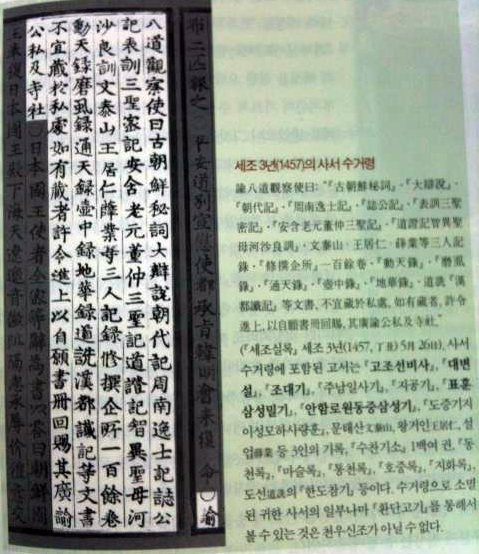
유교를 국교로 신봉한 조선은 개국초에 [춘추]와 [자치통감 강목]만 사필로 여기고, 한민족의 고유 사서를 이단이라 하여 모조리 압수.소각하였습니다. 태종은 서운관에 보관되어 있던 고유 사서를 공자의 가르침에 어긋난다 하여 소각하였고, 세조에서 성종까지 3대에 걸쳐 임금이 전국 관찰사에게 사서 수거령을 내렸습니다.이렇게 하여 우리의 정통 사서가 소실된 것은, 오늘날 우리 역사를 올바르게 인식하는 데 결정적인 타격을 주고 있습니다.
한민족사를 연구하면서도 중국측 사료와 이 땅의 사대주의 사서에 의존하지 않을 수 없게 되었기 때문입니다. 조선 중기 광해군 때 청 태조 누루하치가 보낸 국서를 보면 조선의 사대 근성이 적나라하게 드러나 있습니다. 그 국서에서 누루하치는 “요동은 본시 너희 조선의 땅이다. 지금 명나라 사람들이 그 땅을 빼앗았는데, 너희는 명나라가 원수인 것도 모르고 도리어 신복하고 있다”라고 하면서 조선을 비웃었습니다.
그리고 더욱 가관인 것은 조선 유학자들이 보인 열렬한 모화정신입니다. 이것은 진실로 한국사의 뿌리를 총체적으로 부정하는 망국멸족의 표본입니다. 세종 때 최만리는 훈민정음 제정 반대 상소를 올리면서 “조종 이래 지성으로 중국을 사사하고 모두가 중국 제도를 본받아 왔는데 만약 훈민정음이 중국에 전해지는 날에는 사대모화에 부끄러운 일이다”라고 하였습니다.
동방의 명현이라 불리는 이퇴계 조차 명을 本朝, 즉 ‘우리나라 조정’이라 불렀습니다. 또 우리의 역사에 대해 “단군 시대는 아득한 태고 시대라 증명할 수 없고, 기자가 봉해지고 나서야 겨우 문자를 통했다. 삼국시대 이전은 별로 논할 만한 것이 없다”라고 폄하 하였습니다.
이율곡 또한 명나라 군주를 ‘우리 황상’이라 하고, 명나라 조정을 ‘천조’ 또는 ‘성조’라 불렀습니다. 그리고 [기자실기]를 지어, “기자께서 조선에 이르시어 우리 백성을 천한 오랑캐로 여기지 않고 후하게 길러 주시고 부지런히 가르쳐 주셨다. 우리나라는 기자에게 한없는 은혜를 받았으니 그것을 집집마다 노래하고 사람마다 잘 알아야 할 것이다”라고 하였습니다. 그러면서도 “단군의 출현은 문헌상 상고할 수 없다”라는 한마디로 한민족의 상고 역사 전체를 부정하였습니다.
당대의 실학파 학자들은 어떠했을까요?
[열하일기]로 유명한 박지원은 “명나라는 우리의 상국이다. 상국이 속국에게 내리는 물건은 비록 터럭같이 미미한 것일지라도 마치 하늘에서 떨어진 것 같이 그 영광이 온 나라를 움직이고 경사가 만세에 끼칠것이다”라고 하며 중국을 칭송하였습니다.
실학파의 대표 인물인 정약용도 사대주의에서 벗어나지 못하였습니다. “조선이라는 명칭은 평양에서 시작되었다. 이곳은 본디 기자가 도읍으로 삼은 곳이다”라고 하여, 기자조선이 실존한 것처럼 말하였습니다. 또한 “우리나라는 번국蕃國(오랑캐나라)이니 마땅히 제도가 작아야 한다”라며, 조선은 제후국이니 중국의 관제보다 규모가 커서는 안 된다고 하였습니다.
최인은 이 같은 행태를 두고 “조선은 한일합병으로 망한 것이 아니라 이미 그전에 한중합병으로 망하였다”라고 일갈하였습니다. 조상의 비문 첫머리에 유명조선(명나라에 속한 조선)을 내세우고, 조선 백성을 명의 신민이라 하고, 한문은 진서로 존중하면서 한글은 언서로 무시하였으니, 분명히 한중합병이라는 것입니다.
고려와 조선 역사를 돌이켜보면, 한민족은 참으로 혼 빠진 민족이 아니고 무엇이겠습니까?

———————-
Confucianism, advocated by Confucius, asserts Sinocentrism, which claims China as the center of the world and regards other ethnic groups as mere barbarians subservient to China. The pro-China, Sinocentric worldview adopted by Goryeo and Joseon’s Confucian scholars, who upheld Confucianism as a state ideology, inflicted serious harm upon Korean history by uncritically following this historical perspective.
Goryeo’s Confucian scholars distorted the genealogy of the Korean nation, claiming that it began with Gija Joseon, followed by Wiman Joseon, the Samhan states, and Silla. A central figure in this distortion was Kim Bu-sik of mid-Goryeo, who, in compiling the Samguk Sagi, completely omitted the history of Balhae, successor to Goguryeo, while meticulously detailing the history of Silla up to its fall.
He also criticized Silla for using its own era name, claiming it violated the spirit of vassalage. When Myocheong and Jeong Ji-sang launched a movement to relocate the capital to Seogyeong as a step toward recovering lost territory, Kim Bu-sik and the ruling Confucian elite dismissed it as a conspiracy to seize power.
In Joseon, where Confucianism was upheld as the national religion, texts like Chunqiu and Zizhi Tongjian Gangmu were considered orthodox historiography, while Korea’s native historical texts were labeled heretical and subsequently confiscated and burned. King Taejong ordered the burning of native historical records kept in the Royal Astronomical Bureau, claiming they contradicted Confucian teachings.
From Sejo to Seongjong, three successive kings issued orders to all provincial governors to collect and destroy these books. This led to the irreversible loss of authentic Korean historical texts, critically hindering modern understanding of Korean history.
As a result, research into Korean history became heavily reliant on Chinese records and the pro-China historiography of the Korean peninsula. A glaring example of Joseon’s vassal mentality appears in a letter sent by Qing founder Nurhaci to King Gwanghaegun of Joseon. In it, Nurhaci sarcastically wrote, “Liaodong originally belonged to your Joseon. The Ming took it, and yet you serve the Ming as if you do not even recognize them as your enemy,” ridiculing Joseon’s blind loyalty to Ming China.
Even more appalling was the fervent Sinophilism of Joseon’s Confucian scholars. It was a blatant repudiation of Korean historical identity, a textbook case of national self-negation. During King Sejong’s reign, Choi Man-ri submitted a memorial opposing the creation of Hunminjeongeum (Korean script), stating, “From the founding of our state, we have faithfully learned from China and followed Chinese institutions. If this writing system is transmitted to China, it would be a disgrace to our loyal veneration of Chinese civilization.”
Even Yi Hwang (Toegye), praised as a sage of the East, referred to the Ming dynasty as “our royal court” (本朝) and dismissed early Korean history, saying, “The Dangun period is a remote ancient era and unverifiable. Only after Gija was enfeoffed did writing emerge. The period before the Three Kingdoms is not worth discussing.”
Yi I (Yulgok) also referred to the Ming emperor as “our sovereign” and to the Ming court as “Heavenly Court” or “Sacred Court.” In his Record of Gija, he wrote, “When Gija arrived in Joseon, he did not regard our people as base barbarians, but generously nurtured and diligently educated them. Our country has received boundless grace from Gija, and this must be remembered and praised in every household.” Yet he dismissed Dangun’s emergence with a single sentence: “The appearance of Dangun cannot be verified in historical records,” thereby denying the entirety of ancient Korean history.
What of the Silhak (Practical Learning) scholars of the time?
Park Ji-won, known for Yeolha Ilgi, wrote, “Ming is our superior state. Even a trivial gift from a superior state to its subordinate is like something fallen from the heavens, stirring national celebration and bringing prosperity for generations,” lavishly praising China.
Jeong Yak-yong, a leading Silhak scholar, also failed to break free from this vassal mentality. He asserted, “The name Joseon originated in Pyongyang, which was originally Gija’s capital,” thus treating Gija Joseon as historical fact. He further claimed, “Our country is a tributary state and therefore must have smaller institutions,” arguing that Joseon, as a feudal vassal, should not have larger governmental structures than China.
Commenting on such attitudes, historian Choi In stated, “Joseon did not fall due to the Japan-Korea annexation, but had already fallen due to Sino-Korean annexation.” He argued this based on how epitaphs began with “Joseon, subject to Ming,” how Joseon citizens were called “subjects of Ming,” how classical Chinese was revered as authentic writing while Hangul was derided as a vulgar script — clear signs of a de facto Sino-Korean annexation.
Looking back at the histories of Goryeo and Joseon, one cannot help but ask: were we not truly a people devoid of our own spirit?