

1. 역사 왜곡의 시작, 금살치우禽殺蚩尤.
한. 중 고대사를 왜곡 날조한 첫째 인물은, 2100년 전 한나라 무제 때의 사관 사마천입니다. 당시의 시대 배경을 살펴보면, 북방 흉노족을 정벌한 한무제는 동북아 전역에 중화제국을 건설하려 하였습니다.
그리하여 번조선을 찬탈하여 수립한 위만정권을 멸망시키고, 나아가 고조선의 국통을 계승한 북부여의 영토까지 넘보았습니다. 그러나 동방 조선족의 강력한 저항에 부딪쳐 그 야망은 좌절되고 말았습니다.
이러한 시대적 배경 속에서 사마천은 중국 [이십오사]의 첫머리인 사기를 편찬했는데, 그 첫번째 문구가 치우작란, 금살치우입니다. 4,700년 전에 중국의 시조 황제헌원이 자신에게 복종하지 않고 난을 일으킨 치우라는 인물을 잡아 죽였다는 내용으로 역사의 첫 장부터 왜곡을 한것입니다.
蚩尤作亂하니 不用帝命이라. 於是에 黃帝가 乃徵師諸侯하고 與蚩尤와 戰於 涿鹿之野하여 遂禽殺蚩尤하다.(사기-오제본기) 치우가 난을 일으키니 황제의 명이 소용없었다. 이에 황제가 군사를 징발하고 제후를 모아 치우와 탁록의 들에서 싸워 마침내 치우를 잡아 죽였다.(사기-오제본기)
사기에서는 이 전쟁의 승리가 헌원의 것이었고, 치우는 죽임을 당했다고 사실을 반대로 뒤집어 기록했습니다. 그리하여 동북아 역사와 문명의 뿌리를 헌원 중심으로 조작하고, 중국이 천하의 중심, 천자국이며 주변 민족은 모두 야만족이라는 중화사관을 만들어 내기에 이르렀던 것입니다.
사기 봉선서에 보면 “이에 진시황이 동쪽에 이르러 바다를 유람하고, 명산대천과 팔신에 제를 올리며 신선의 도를 구하였다. 팔신제는 예로부터 그곳에서 지내던 것으로, 혹은 강태공이 만들어 전해 내려오는 것이라고 했다….(중략) 팔신에서 첫째는 천주로….(중략) 셋째는 병주로 치우를 제사지낸다. 치우사는 동평 육감향에 있으니 제의 서쪽이다“ 라고 하였습니다.
치우 천황이 헌원에게 패하고 죽임을 당했다면, 진시황은 왜 치우천황을 兵主로 모셨을까요? 게다가 이제와서 중국은 수천 년동안 지켜 온 황제의 자손이라는 주장을 버리고 1980년대 이후 황제와 염제를 90년대 이후에는 중화삼조당을 세워 황제와 염제 그리고 치우, 모두가 자신의 시조라고 주장하고 있습니다.
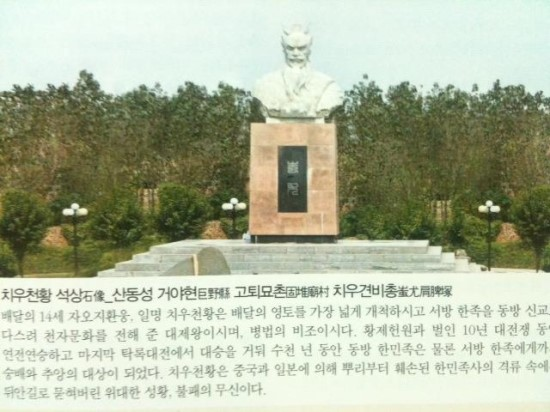
2. 치우 천황은 누구인가?
치우천황에 대해 삼성기 하에서는 이렇게 말하고 있습니다.
“다시 몇 대를 내려와 14세 자오지환웅이 계셨으니, 이 분은 신이한 용맹이 매우 뛰어나 구리와 철로 투구를 만들어 쓰고 능히 큰 안개를 일으키며, 구치를 제작하여 광석을 캐내 이 철을 주조하여 무기를 제작하시니 천하가 모두 외경하였다. 그리하여 세상에서는 이 분을 치우천황이라 불렀는데, 치우란 세속에서 말하길 ”뇌우가 크게 일어 산하가 뒤바뀐다“는 뜻이다”
또 규원사화에서는 智爲라는 말이 힘있고 용기있는 사람이라는 뜻인데 치우에서 온 것이라고 하였습니다. 삼성기 하 신시역대기에서 보듯이 치우천황의 본래 호칭은 자오지환웅입니다. 박현은 “자오지에서 자오는 땅을 넓힌다, 지는 치로 변하기 전의 소리로 이끄는 사람이라는 뜻이다.
또한 여기서 오는 삼족오의 오로 태양을 상징하는 말이고, cha 나 chi 는 군사의 라는 의미의 古 만주. 몽골어이며, o 나 u는 위 또는 키우다의 의미가 있다. 따라서 치우는 군의 우두머리, 군사적으로 확대된 軍神 등의 의미다“ 라고 주장하였습니다(치우학회, [치우연구] 제2호)

—————————-
- The Beginning of Historical Distortion: Geumsal Chiwoo (禽殺蚩尤)
The first figure to falsify and distort the ancient histories of Korea and China was Sima Qian, the historian of the Han Dynasty under Emperor Wu, about 2,100 years ago. At that time, Emperor Wu had subdued the northern Xiongnu and sought to build a Sinocentric empire across Northeast Asia.
He destroyed the Wiman regime, which had usurped the throne of Gojoseon, and even set his sights on the lands of Bukbuyeo, which had inherited the lineage of Gojoseon. Yet his ambitions were thwarted by the fierce resistance of the Eastern Joseon people.
It was in this historical context that Sima Qian compiled the Records of the Grand Historian (Shiji), the opening volume of the Twenty-Four Histories. And the very first line of that text introduced a distortion: Chiwoo’s Rebellion, Geumsal Chiwoo (禽殺蚩尤). According to the Shiji, 4,700 years earlier, the Yellow Emperor (Xuanyuan) crushed a rebellion led by Chiwoo, who refused to submit, and killed him in the Battle of Zhuolu.
“蚩尤作亂하니 不用帝命이라. 於是에 黃帝가 乃徵師諸侯하고 與蚩尤戰於涿鹿之野하여 遂禽殺蚩尤하다.” (Shiji, Annals of the Five Emperors)
“Chiwoo rebelled, disobeying the emperor’s command. The Yellow Emperor then summoned the lords and fought Chiwoo in the fields of Zhuolu, finally capturing and killing him.”
But this account inverted the truth. In fact, Chiwoo triumphed, yet the Shiji credited the victory to Xuanyuan and declared Chiwoo slain. Thus, the roots of Northeast Asian history and civilization were rewritten around Xuanyuan, fabricating the Sinocentric historiography that cast China as the Middle Kingdom — the empire of the Son of Heaven — and branded all surrounding peoples as barbarians.
Yet in the Shiji “Fengshan Shu,” we find:
“When the First Emperor of Qin traveled east, he toured the seas, offered sacrifices to sacred mountains, rivers, and the Eight Spirits, and sought the way of the immortals. Among the Eight Spirits, the first was Tianzhu (Heavenly Lord)… the third was Bingzhu (Lord of War), who was Chiwoo. The shrine of Chiwoo was at Dongping in Liugam-hyang, west of the ritual site.”
If Chiwoo had truly been defeated and killed by Xuanyuan, why did Qin Shihuang venerate him as Bingzhu, the Lord of War? Furthermore, after centuries of claiming descent from Xuanyuan alone, since the 1980s China has shifted its narrative. In the 1990s it even erected the Zhonghua Sanzu Tang (Shrine of the Three Ancestral Progenitors of China), now declaring Xuanyuan, Yandi, and Chiwoo all as its ancestors.
- Who Was Chiwoo Cheonhwang?
According to the Samseonggi (Lower), Chiwoo is described as follows:
“Several generations later came the 14th Hwanung, Ja-oji Hwanung. He was of divine and extraordinary might, forging helmets of bronze and iron, conjuring great mists, and crafting tools to mine ores, smelting the iron into weapons that commanded awe across the world. Thus, he was called Chiwoo Cheonhwang. The name Chiwoo, in common speech, means ‘when thunder and storm arise, overturning mountains and rivers.’”
The Gyuwon Sahwa further explains that the word chiwei (智爲), meaning a person of great strength and courage, derives from Chiwoo. In the Samseonggi’s “Chronicles of Shinshi,” Chiwoo’s true title is given as Ja-oji Hwanung. Scholar Park Hyeon interprets:
“In Ja-oji, ja-o means to expand the land, and ji (later pronounced chi) means one who leads. The syllable o also denotes the three-legged crow, a symbol of the sun. In ancient Manchu and Mongolic tongues, cha/chi meant ‘military,’ while o/u meant ‘up, leader, to nurture.’ Thus, Chiwoo signifies the supreme commander of armies, a deified god of war.” (Chiwoo Studies Association, Chiwoo Research Vol. 2)