
제대로 된 환경분석을 위해서는 충분한 정보를 확보해야 하기 때문에, 기업은 다양한 마케팅 조사를 통해 각종 데이터와 정보를 수집하고 있다.
데이터는 관찰이나 측정을 통해서 수집된 사실(Fact) 또는 값(Value)들이 정리되어 있는 것을 의미하며, 정보란 적절한 의사 결정을 할 수 있도록 수집된 데이터를 해석하고 가공한 형태를 의미한다. 그러므로 기업의 성공적인 마케팅 전략은 단순한 데이터가 아닌, 마케팅 전략 수립에 필요한 가공된 정보를 올바르게 파악하는 것이 그 무엇보다도 중요하다.
이렇게 올바른 정보를 수집했다면, 본격적으로 SWOT 분석을 통해 전략적 방향을 도출할 수 있다. SWOT 분석은 강점(Strengths), 약점(Weaknesses), 기회(Opportunities), 위협(Threats)의 이니셜을 붙인 것으로써, 기업을 둘러 싼 외부환경의 기회와 위협, 기업 내부 역량의 강점과 약점을 분석하여, 신제품 출시 및 기존 제품에 대한 시장에서의 가능성을 파악하고, 감점을 강화하거나 약점을 보강하는 등의 마케팅 전략적 방향을 제시해 준다.
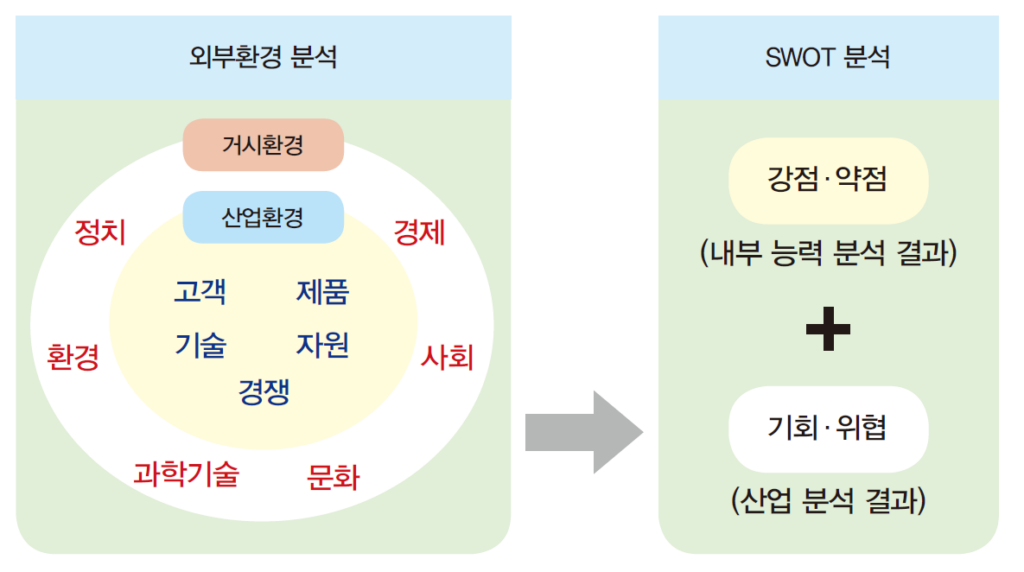
① 외부환경 분석 : 특정 제품(신제품 및 기존 제품)에 영향을 미치는 정치, 경제, 사회, 문화 등의 거시환경과 제품이 속한 산업 내 고객의 트렌드, 경쟁사 현황, 기술의 변화 등의 산업환경이 있다. 외부환경이란 우리가 통제할 수 없는 어쩔 수 없는 상황이다. 정부의 법규, 사회적 트렌드, 스마트폰의 비약적인 기술의 발전, 경쟁사의 신제품이나 마케팅 전략 등은 내가 바꾸고 싶어 바꿀 수 있는 것들이 아니다.
따라서 외부환경의 변화는 기업에게 위협(Threat)이 될 수도 있고 기회(Opportunity)가 될 수도 있기 때문에, 기업은 외부환경 분석을 통해 위협을 사전에 예측하고 피해가도록 해야 하며, 시장의 기회를 발견하여 공격적인 시장 침투 또는 확대 전략을 수행할 수가 있다.
외부환경에는 기본적으로 제품에 잠재적으로 영향을 미칠 수 있는 거시적인 환경요인으로써, ‘STEP Model’이 있다.
• 사회문화 환경(Socio-cultural) : 인구통계, 소비자 트렌드, 라이프 스타일
• 기술 환경(Technological) : 기술적 변화 및 트렌드(사용자 편리성, 제품의 축소화/경량화, ICT, AI, 모바일 기술발전 등)
• 거시경제 환경(Economic) : 국내외 경제지표, 산업 전반적 추세(시장의 크키, 점유율, 성장추세)
• 정책규제 환경(Political Regulatory) : 법률의 변화, 외교정책, 정부규제.
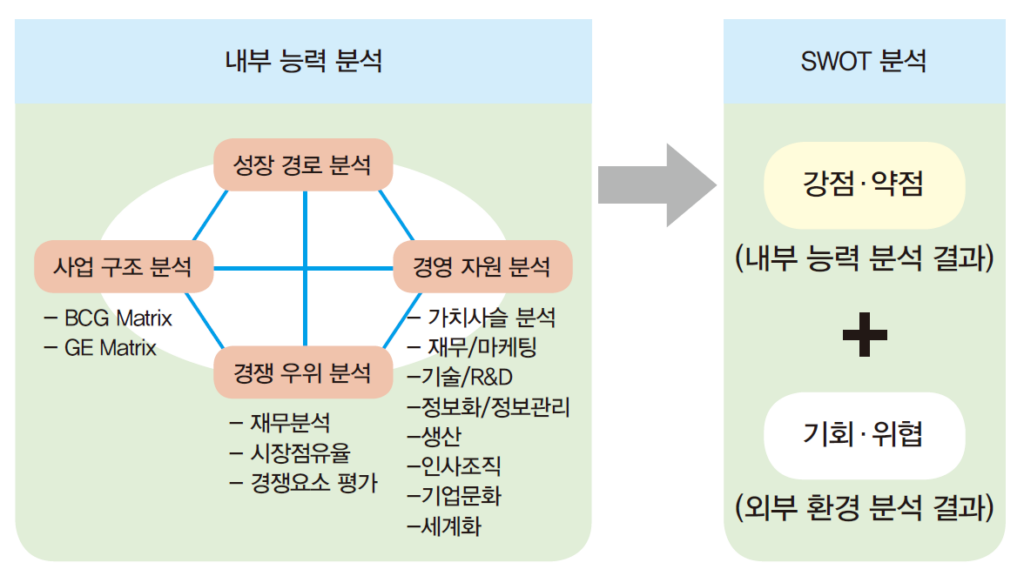
② 내부환경 분석 : 기업이 보유하고 있는 자금력, 기술력, 유통력, 마케팅력, 인적자원 등의 내부적 역량이 산업 내에서 경쟁사에 비해 차지하고 있는 정도로써, 기업의 강점(Strength)과 약점(Weakness)으로 평가된다. 따라서 외부환경과 달리, 내부환경은 기업의 노력에 의해 통제할 수 있는 변수들이므로, 기업은 강점을 강화하고 약점을 보강하여 경쟁 우위를 확보하는 노력을 할 수가 있다.
SWOT 분석에 반드시 주의할 점이 있다. 우리가 통제할 수 없는 외부환경변수의 기회를 마치 강점인양 오인한다거나, 회사의 혁신적인 신제품 개발이라는 강점을 시장의 기회요인으로 오인하는 것이다. SWOT 분석에서 이를 잘못 배치하면 기회를 잡고 강점을 강화하는 기본 전략적 방향이 잘못될 수 있다.
따라서 외부환경과 내부환경을 헛갈려 하면 안 된다. 최근에는 마케팅 부서뿐만 아니라 R&D, 생산, 관리 부서 등, 다른 부서에서도 사업계획서를 만들 때 SWOT 분석이 안 들어가면 이상할 정도로 많이들 사용하고 있다. 하지만 대부분이 생각나는 대로 대충 적은 것으로써, 엄청난 자료와 리서치를 바탕으로 만들어진 제대로 된 한 장짜리 SWOT 분석표를 보기는 쉽지가 않다.
앞서 환경분석은 바로 마케팅전략 수립의 선행단계라고 말했듯이 “환경분석→SWOT→전략 방향→전략 수립→실행”이라는 연결선상에 놓여 있어야 한다. 즉, 환경분석에 근거한 SWOT분석이어야 하며, SWOT 분석에 근거한 전략이어야 한다는 것이다. 남들이 다 하니까 마지못해 SWOT 분석표 한 장 올려놓고, 막상 전략은 엉뚱하게 흘러간다면 그것은 제대로 짜여진 전략이라고 볼 수가 없다.
To perform a proper environmental analysis, companies must secure sufficient information, which is why they collect various data and information through a wide range of marketing research.
Data refers to organized facts or values collected through observation or measurement, whereas information refers to data that has been interpreted and processed to enable appropriate decision-making. Therefore, the success of a company’s marketing strategy relies above all on correctly understanding processed information needed for strategy formulation, rather than relying on raw data.
Once valid information has been gathered, a company can derive strategic directions in earnest through SWOT analysis. SWOT analysis—an acronym for Strengths, Weaknesses, Opportunities, and Threats—analyzes external environmental opportunities and threats as well as internal organizational strengths and weaknesses. This helps identify market potential for new and existing products and provides strategic marketing directions, such as reinforcing strengths or mitigating weaknesses.
① External Environment Analysis: This includes macro-environmental factors such as political, economic, social, and cultural elements that affect a specific product (new or existing), as well as industry environment factors such as customer trends, competitor status, and technological changes within the industry. The external environment consists of uncontrollable situations beyond our command. Government regulations, societal trends, rapid technological advances in smartphones, and competitors’ new products or marketing strategies are not things we can change at will.
Therefore, because changes in the external environment can pose threats or present opportunities, companies must predict threats in advance to avoid them through external environment analysis, while discovering market opportunities to execute aggressive market penetration or expansion strategies.
The external environment basically incorporates the ‘STEP Model’ as macro-environmental factors that can potentially impact products: • Socio-cultural Environment: Demographics, consumer trends, lifestyle • Technological Environment: Technological changes and trends (user convenience, product miniaturization/lightweighting, ICT, AI, mobile technology advancement, etc.) • Economic Environment: Domestic and international economic indicators, overall industry trends (market size, market share, growth trends) • Political/Regulatory Environment: Legal changes, foreign policy, government regulations
② Internal Environment Analysis: This evaluates the extent to which internal capabilities—such as financial resources, technological prowess, distribution network, marketing capability, and human resources—hold a position relative to competitors within the industry, categorized as company Strengths and Weaknesses. Unlike the external environment, the internal environment consists of controllable variables through company efforts, allowing businesses to make deliberate efforts to strengthen their advantages and supplement their weaknesses to secure a competitive edge.
There is a critical precaution to keep in mind when conducting a SWOT analysis: misinterpreting an external environmental opportunity beyond our control as an internal strength, or confusing an internal strength like innovative product development with a market opportunity. Placing these incorrectly within a SWOT matrix can misdirect the fundamental strategic direction aimed at capturing opportunities and leveraging strengths.
Therefore, one must not confuse the external environment with the internal environment. Recently, SWOT analysis has become so ubiquitous that an order or business plan looks incomplete without one, not only in marketing departments but also in R&D, production, and administrative units. However, most SWOT tables are roughly put together based on passing thoughts, making a properly structured, one-page SWOT analysis based on extensive data and research hard to find.
As noted earlier, environmental analysis serves as a prerequisite step for marketing strategy formulation and must follow a connected logical sequence: “Environmental Analysis → SWOT → Strategic Direction → Strategy Formulation → Execution.” In other words, a SWOT analysis must be grounded in environmental analysis, and strategy must be derived directly from the SWOT analysis. If a company merely attaches a generic SWOT matrix because everyone else does, only for its actual strategy to diverge in an entirely unrelated direction, it cannot be considered a properly crafted strategy.