마케팅조사에는 정량조사(Quantitative Research)와 정성조사(Qualitative Research)가 있다. 정성조사와 정량조사는 서로 상반대는 강ㆍ약점이 있으므로, 정성조사와 정량조사를 동시에 수행하는 것이 바람직하나, 프로젝트의 목적이나 상황, 예산이나 시간적인 제약 등에 따라 두 가지 조사방법 중 한 가지만 진행해도 무방하다.
과거 나는 새로운 브랜드를 런칭하기 위해 단 한 번의 조사에서 멈추지 않고, 브랜드의 시장성 및 가능성을 알아보기 위한 소비자의 제품 사용실태를 파악하는 A&U조사(Attitude & Usage Test – 정량조사)를 하였고, 소비자의 깊은 속마음을 파악하기 위해 FGI조사(Focus Group Interview – 정성조사)도 많이 하였으며, 바로 제품이 출시되기 직전에는 시제품을 소비자가 직접 집에서 사용해보게 하고 의견을 받는 HUT조사(Home Using Test – 정량조사)도 하였다.
산업마다 다르겠지만, 지금은 시장트렌드가 너무 빨라 이런 걸 다해서 제품을 출시하면 너무 늦는다는 구실로 마케팅조사를 생략하는 경우가 많은데, 시간과 비용과 노력이 가능한 여건이라면, 주요 브랜드 런칭에서는 반드시 해볼 필요가 있다.
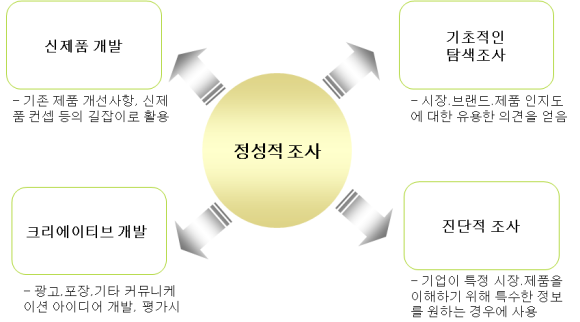
먼저 정성조사는 확률적 기초에 근거를 둔 샘플이 아닌, 적은 인원의 소비자들을 대상으로 하여, 직접 보고 들으면서 그들의 니즈나 원츠를 심층적으로 조사하는 것이다. 따라서 정성조사는 대규모의 정량조사를 실시하기 전에, 예비적 정보수집을 통해 가설을 수립한 후 정량 조사로써 검증하고자 할 때, 또는 정량조사의 결과에서 불투명한 점을 더 깊이 찾아내고자 할 때 등…, 다음과 같은 경우에 사용하면 좋다.
1) 형식에 얽메이지 않고 자유로운 질의 응답.
2) 합리적인 설명이 불가능하거나 피상적인 내용에 대한 답변을 얻을 수 있음.
3) 소비자의 독창적 아이디어를 이끌어 내려는 데 이용.
4) 양적인 조사의 사전 단계, 가설의 발견, 예비적 정보의 수집, 사전 지식이 부족한 경우
5) 가설의 질적 검증 및 의미의 확인(정량조사 결과에 대한 의미 확인, 가설의 검증)
6) 소비자 언어의 발견 및 확인
7) 소비자를 깊이 이해하려는 시도
8) 다량의 샘플링이 어려운 경우.
9) 신속한 조사.
정성조사는 현 시장 내에서 소비자 욕구의 발견, 기존 제품의 개선방향, 신제품 아이디어의 수집 및 개발 방향에 대한 힌트, 소비자 특성간 욕구 구조의 차이, 향후 시장변화 에 대한 예측, 컨셉트 수용도 및 개선점의 발견, CF에 대한 평가 및 개선 방향 파악, 용기 및 상표명에 대한 평가 혹은 아이디어 수집, 새로 참여하려는 분야의 제품과 생활에 대한 전반적인 정보 수집을 목적으로 활용된다.
그러나 정성조사는 수치로 명확하게 제시되지 않을뿐만 아니라, 작은 표본으로 인해 신뢰도와 타당성이 부족하여 조사결과에 대한 설득력이 약하고, 조사자의 자질에 따라 영향을 많이 받기 때문에 조사결과의 해석이 주관적일 수도 있어서, 조사결과를 전체 시장에 일반화할 수 없는 한계점이 있다.
To conduct marketing research, obtaining data is the highest priority. When such data is gathered and processed through an analytical process to become useful for decision-making, it is called information. Therefore, let us examine what types of data form the most fundamental basis of marketing research.
Data is broadly categorized into primary data and secondary data. Primary data refers to data collected directly through research, whereas secondary data refers to existing data already published by reputable institutions, government bodies, media outlets, research firms, academic papers, and research presentations.
Because primary data requires significant cost and time—often utilizing professional research agencies—it is essential to thoroughly review several factors before starting: whether it is truly necessary for marketing decision-making, what specific problem needs to be solved, whether the research objectives are clear, and which consumers’ opinions are required. Therefore, before embarking on primary research, collecting secondary data—the easily accessible existing data—is extremely important.
Secondary data can be gathered from published information within and outside the company, news articles, current status and outlook reports published by financial analysts, publications from government agencies (such as Statistics Korea, HIRA, and the Ministry of Economy and Finance), academic research papers by graduate students or university professors, public disclosures from industry competitors, and reports published by specific industry associations.
In addition, companies can purchase research data compiled by professional research firms for multiple clients (such as IMS Data, Datamonitor, Euromonitor, Nielsen Data, and TNS) or download and utilize freely available public data via the Internet.
Through the collection of secondary data, companies can forecast the feasibility of new or existing ventures and directly make marketing decisions. Alternatively, to test hypotheses formulated through secondary data, companies can conduct additional marketing research directly to collect and analyze primary data for final decision-making.
What matters most, however, is being able to grasp the true essence through research. Author Lee Oesoo wrote in his book Cheongchun Bulpae:
“The mountain stands still, yet its ridge flows; the river flows, yet its bed stands still. Even if you have seen both, do not say you have seen the true form of the mountain and the river. A mountain is not merely a mountain, and water is not merely water.”
Through marketing research, marketers must see beyond what is visible on the surface. Only then can they encounter the dynamic mountain and quiet water previously unseen, uncovering customers’ true inner feelings that even they themselves may not fully realize. Therefore, the analysis of secondary data in environmental analysis is critical not only for saving time and money, but also for collecting accurate primary data.
During my doctoral studies in marketing, I published four research papers. In such academic papers, establishing new hypotheses based on literature reviews (secondary data) analyzing previously published papers is always the top priority. Following that, collecting and analyzing primary data through research to verify whether the hypothesis is true or false represents the basic thesis-writing pattern in the social sciences.
To avoid GIGO (Garbage-In, Garbage-Out) and achieve research objectives, the content of information that must be obtained through research must be precisely defined. An ambiguous awareness of the problem—such as liking everything without clear boundaries—or excessive greed can degrade the quality of the entire investigation. Because the data obtainable from a single study has clear limitations, establishing and reviewing hypotheses through secondary data collection within those limits is crucial for achieving objectives most effectively.
However, when people generally refer to marketing research, it is often represented by the collection of primary data. As it is the most vital research method, secondary data collection can ultimately be considered a preliminary stage for primary data collection. Therefore, please understand that the marketing research methods introduced next refer directly to primary data research.