타겟팅은 좀더 쉽게 말하면 마케팅 커뮤니케이션의 핵심 대상을 선정하는 일이라고 말할 수 있다. 즉, 핵심고객을 선정함으로써, 경쟁사와의 비교 우위를 발견하고, 브랜드 아이덴티티(Brand Identity)를 확립하여 커뮤니케이션을 하고, 브랜드를 확산시키는 일이 마케팅 전략이다.
즉, 핵심고객을 선정함으로써, 그들의 감추어진 욕구(Unmet Needs)를 파악하여 경쟁적 우위를 강화하는 한편, 기업이 가지고 있는 브랜드 효익(Brand Benefit)을 제공하기 위해 끊임없는 커뮤니케이션을 하는 것이다. 그런 의미에서 타겟팅은 브랜드가 가지고 있는 독특한 개성(Brand Personality)을 결정짓는 중요한 과정이기도 하다.
따라서 우리는 타겟팅을 통해 핵심 고객이 가지고 있는 A&U(Attitude & Use) 및 깊은 성향을 파악하고 이를 다음과 같은 네 가지 측면에서 브랜드에 반영할 수도 있다.
1. Attribute : 제품의 본질적 속성의 발견.
2. Benefit : 소비자에게 어떤 이익과 장점을 제공하는가?, 경쟁 브랜드보다 우수한 기능적, 감성적 기대치는 무엇인가? –> Functional Benefit & Emotional Benefit.
3. Value : 다른 브랜드에 비해 소비자에게 제공되는 가치는 무엇인가?.
4. Personality : 브랜드를 사람이라고 가정한다면 어떤 종류의 사람인가? 인간적 특성에 투영시킨 브랜드 이미지는 무엇인가?
이와 같은 방법으로 핵심고객을 정의할 수 있다. 아래의 표는 어느 화장품 회사에서 고급 화장품을 런칭하기 위해 타겟팅한 사례이다.
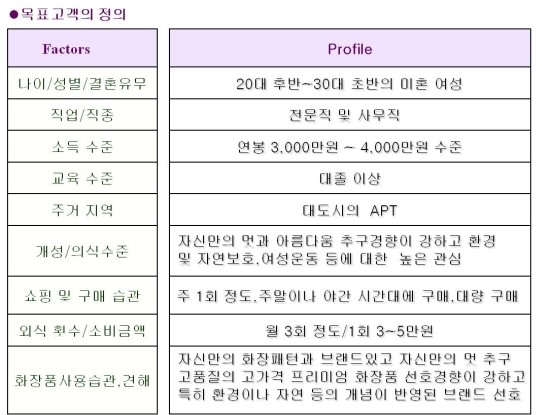
많이 오래되었지만, 애경산업에서 마리끌레르(marie claire) 화장품을 런칭(Launching) 했던 타게팅 사례를 소개한다. 나는 수 차례의 정량조사와 정성조사를 통해 마리끌레르 화장품의 핵심고객을 선정하였고, 이에 따라 제품개발 방향 및 마케팅전략을 수립하였다. 그 결과 마리끌레르는 런칭 1년 만에 년 200억원 대의 매출을 올리며 애경산업이 화장품 전문회사로 발돋움하게 만든 히트 브랜드가 되었다.
1. Target.
A. Core Target : 유행과 Fashion에 민감한 20-23세의 여대생.
B. Secondary Target : 여대생을 꿈꾸는 10대 후반 여고생, 다시 여대생으로 돌아가고 싶은 20대 후반~30대 직장인 및 주부.
2. Brand Personality.
A. 유행과 Fashion의 시작, Frontier –> Leader.
B. 기존 유명 브랜드에 대한 충성도가 아직 생성되어 있지 않음.
C. 밝고 긍정적이며, 자신만의 개성 보유.
D. 소녀에서 여성으로~
사실 1차 FGI 결과는 20대 여대생 타겟보다 더 올드했다. 당시 한국에서 마리끌레르 브랜드는 이미 패션으로 라이센스 되어 있는 진도모피의 영향으로 올드한 이미지를 가지고 있었기 때문에, 이에 대한 연상작용으로 마리끌레르 화장품의 타겟 역시 30대 이상의 여성으로 나왔다.
하지만 마리끌레르는 화장품전문점에서 판매할 중고가 브랜드였으며, 30대 여성은 이미 사용하고 있는 브랜드에 대한 충성도가 강해서 화장품 브랜드를 바꾸지 않으려는 경향이 크다는 것을 잘 알고 있었기 때문에, 나는 그들이 초창기 마리끌레르의 핵심고객이 되리라 생각지 않았다.
그래서 나는 1차 FGI 조사결과를 무시하고, 시장의 기회를 발견한 시판시장의 프랑스 브랜드란 세분화된 시장에서 처음 화장품을 사용하는 20대 여대생을 타겟으로 디자인을 요청하였다. 그리고 디자인 시안이 나온 후, 이를 검증하기 위해 1차때와 같은 패널들에게 2차 FGI를 실시하였는데, 디자인을 보여준 후의 결과는 20대 젊은 여성으로 조사결과가 나왔다.
In simpler terms, targeting can be defined as selecting the core audience for marketing communications. In other words, marketing strategy is the process of discovering a competitive advantage over rivals, establishing brand identity to communicate effectively, and expanding the brand by selecting core customers.
That is, by selecting core customers, a company identifies their hidden needs (Unmet Needs) to reinforce its competitive advantage, while continuously communicating to deliver the brand benefits it possesses. In this sense, targeting is also a critical process that determines a brand’s unique personality (Brand Personality).
Therefore, through targeting, we can grasp the A&U (Attitude & Usage) and deep inclinations of core customers, incorporating them into the brand across the following four dimensions:
- Attribute: Discovering the intrinsic attributes of the product.
- Benefit: What advantages and profits does it provide to consumers? What functional and emotional expectations exceed those of competing brands? –> Functional Benefit & Emotional Benefit.
- Value: What value is provided to consumers compared to other brands?
- Personality: If the brand were a person, what kind of person would it be? What is the brand image projected onto human characteristics?
Core customers can be defined using these methods. The table below illustrates a targeting case used by a cosmetics company to launch high-end cosmetics.
Though it was quite some time ago, I would like to introduce a targeting case from when I launched Marie Claire cosmetics at Aekyung Industrial. Through several rounds of quantitative and qualitative research, I selected the core customers for Marie Claire cosmetics and established product development directions and marketing strategies accordingly. As a result, within just one year of its launch, Marie Claire achieved annual sales in the 20 billion KRW range, becoming a hit brand that propelled Aekyung Industrial to step up as a specialized cosmetics company.
1. Target
- A. Core Target: Female college students aged 20–23 who are sensitive to trends and fashion.
- B. Secondary Target: High school girls in their late teens dreaming of becoming college students, as well as working women and homemakers in their late 20s to 30s who wish to return to their college years.
2. Brand Personality
- A. Frontier at the start of trends and fashion –> Leader.
- B. Loyalty toward existing famous brands has not yet been formed.
- C. Bright, positive, and possessing a unique individuality.
- D. Transitioning from a girl to a woman~
In fact, the results from the initial FGI were older than the target group of female college students in their 20s. At that time in Korea, the Marie Claire brand possessed an older image due to the influence of Jindo Fur, which had already licensed the brand name for fashion. As an associative reaction to this, the target for Marie Claire cosmetics initially emerged as women in their 30s and older.
However, Marie Claire was a mid-to-high-priced brand intended for sale in cosmetics specialty stores, and I was well aware that women in their 30s had strong brand loyalty toward the products they were already using, showing a strong reluctance to switch cosmetics brands. Therefore, I did not believe they would become the core customers for Marie Claire in its early stages.