삼십 분 후 내가 회의실에 들어갔을 때는 이미 의논이 끝 난 뒤였다. 그들은 내 의견에 대해 약간의 수정을 하였지만, 내가 준비했던 차선 안 범위에 들어가기에 충분히 수용 가능한 조건이었다. 나는 흔쾌히 승낙하며, 예상 밖으로 협상이 잘 되어 간다고 생각했었지만, 그건 오산이었다.
그들은 약간의 뜸을 들이다가 마침내 진정한 속내를 드러냈다. 그것은 새로 영업을 준비하는 기간이 필요하므로, 첫 달에는 아무런 매출 조건 없이 일 인당 오만 위안을 지원해 달라는 요청이었다. 이는 프로 스포츠 선수들이 이적을 할 때 받는 일종의 스카우트 비용 같은 개념이었다.
하지만 중국에서 오만 위안이면 대리급 도시 근로자의 연봉에 해당하는 거액으로, 그들이 앞으로 매출을 얼마나 할 수 있을지도 의심스러운 판국에 선뜻 들어줄 수 있는 금액이 아니었다. 내가 그들의 요구대로 상당 부분을 수용하였는데도 불구하고, 개인적인 욕심이 과하여 이런 큰 금액을 요구하는 걸 나는 받아들일 수가 없었다.
나는 회사가 이런 식으로 계약을 한 번도 해준 적이 없다고 단호하게 거절하는 한편, 우리 회사의 다른 장점을 부각시켜 그들을 다시 설득하였지만 소용이 없었다. 이것만은 그들도 절대로 양보할 수 없다는 것이었다.
그렇게 설왕설래 반복되는 이야기가 오가며 시간만 지나가자, 나는 더 이상 무의미하다는 것을 느끼고는, 다시금 그들을 한번 쭉 둘러보며 발언을 주도하는 사람이 누구인지 살펴보았다. 그러자 네 명 중 두 명이 주도적으로 의견을 이끌고 있었고, 나머지 두 명은 말없이 따라가는 분위기임을 알 수 있었다.
그제야 나는 이것이 가장 큰 걸림돌이라는 것을 깨달았다. 그래서 내가 애초부터 이들을 한곳에 모아놓는 게 문제라고 하지 않았는가? 이들이 뭉쳐 있는 한, 우리에게 유리한 협상으로 이끌어 내기는 쉽지 않을 것이 분명했다. 이젠 내가 결단을 내려야 할 때였다.
나는 그들의 요구를 딱 자르듯이 거절했다. 순간 모든 것이 멈춘 듯 정적만이 회의실을 가득 채웠다. 그리고 그 정적을 가장 먼저 깬 것도 나였다.
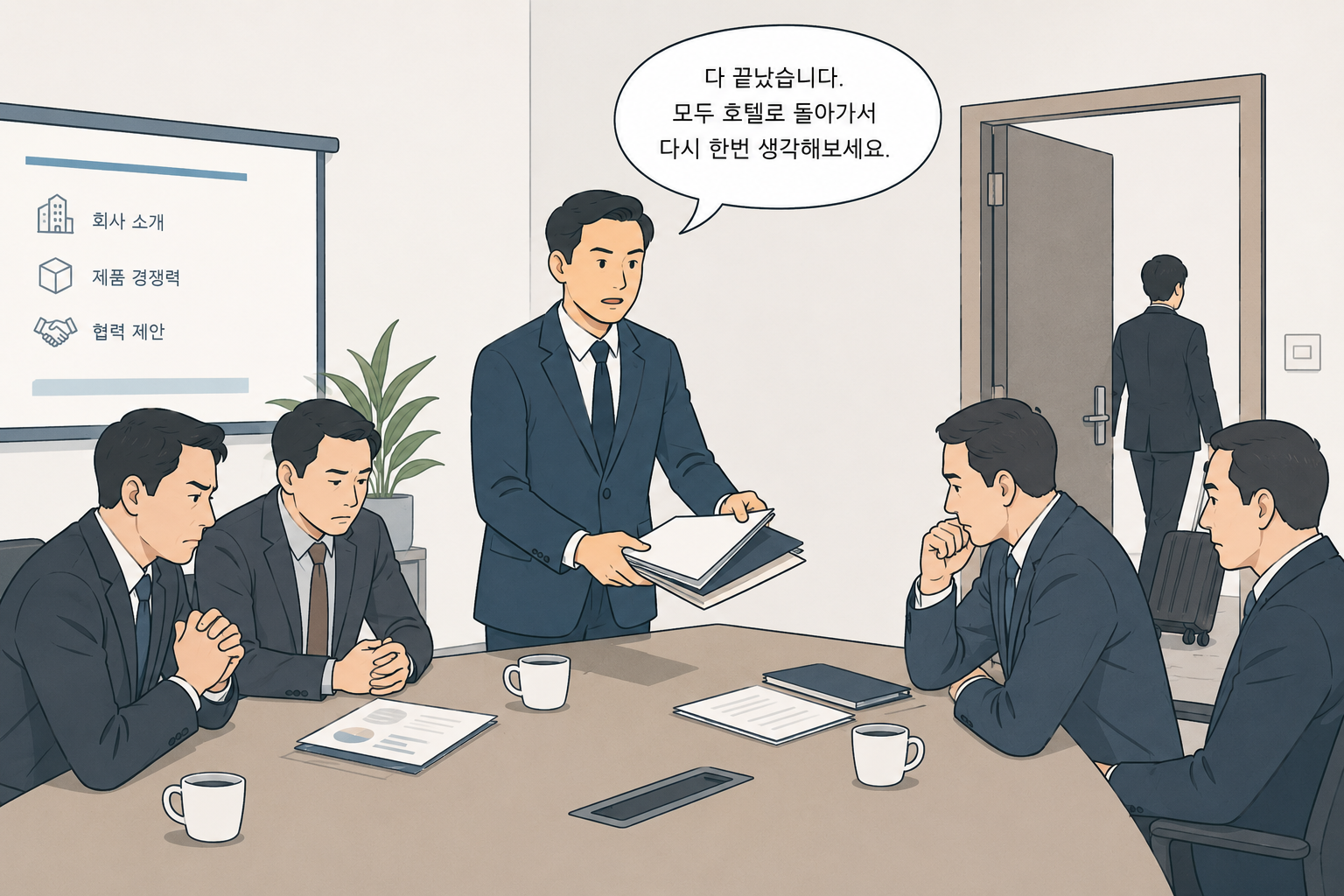
“자, 다 끝났습니다. 모두들 호텔로 돌아가서 다시 한 번 생각해보세요. 제가 여러분에게 해줄 수 있는 것은 여기까지입니다. 멀리서 오셨는데 안타깝지만, 부디 안녕히 돌아가시기 바랍니다.”
나는 통역이 나의 말을 전달하는 사이, 그들에게 건네주었던 모든 자료들을 일부러 내가 직접 회수했다. 그리고 그때 나의 눈은 그들의 당혹스러워하는 표정을 하나도 놓치지 않았다.
그들이 주섬주섬 짐을 정리하고 호텔로 돌아가는 길에 나는 쉬 이사에게 전화를 하여, 따로 만나고 싶다고 했다. 쉬 이사는 이번 협상을 시작하게 된 발단이자 조직의 책임자였으며, 어떡하든 계약을 성사시키고 싶어 하는 사람이었기에, 나는 이들을 해산시킨 후 다시 원점으로 돌아가 쉬 이사와 담판을 짓기로 한 것이다.
‘뭉치면 살고 흩어지면 죽는다’란 속담이 있다. 아마도 이 속담은 동북에서 함께 온 그들에게 해당되는 말이라 생각된다. 그렇다면 반대로 내 입장에서는, ‘그들이 뭉치면 나는 죽고, 흩어지면 산다’인 것이다. 따라서 내가 최우선적으로 해야 할 일은 그들을 뭉치지 못하게 하는 것이었다.
병법36계에도 ‘위위구조(圍魏救趙)’라는 말이 있다. 이는 강한 적을 분산시켜 쳐부순다는 전략이다. 전국시대에 위나라의 대군에게 공격을 받아 도읍인 한단을 포위당한 조나라는 이웃의 제나라에게 구원을 요청했다. 제나라는 급히 한단으로 진격하려 했지만, 군사인 손빈이 이를 막았다.
손빈은 위나라 군사와의 정면 승부는 세력적으로 불리하므로, 수비가 상대적으로 허술한 위나라의 수도를 공격하면, 위나라는 한단의 포위를 풀고 철수할 것이므로, 그때를 노려서 총 공격을 하자고 했다. 그 결과 제나라는 결국 대승을 거두었고, 아울러 조나라도 구하게 되었다고 한다. 이런 점에서 킹 핀인 쉬 이사야말로 내게 있어서는 위나라의 수도였다. (계속)

Thirty minutes later, when I returned to the conference room, they had already finished their internal discussion. They proposed a few minor revisions to my offer, but everything remained well within the range of the alternative proposal I had prepared, making the terms entirely acceptable. I gladly agreed, believing the negotiations were progressing better than expected. However, I was mistaken.
After a brief pause, they finally revealed their true intention. They requested that, because they needed time to establish their new sales operations, the company provide each of them with RMB 50,000 during the first month without imposing any sales targets. It was essentially a signing bonus, similar to the transfer fee or signing incentive that professional athletes receive when joining a new team.
However, RMB 50,000 was equivalent to the annual salary of a worker in a prefecture-level city in China. Given that there was still considerable uncertainty about whether they would generate meaningful sales in the future, this was by no means an amount that could be approved lightly. Although I had already accepted a substantial portion of their demands, I found it impossible to accept such an excessive request driven by personal gain.
I firmly rejected the proposal, explaining that our company had never entered into a contract under such terms. At the same time, I attempted to persuade them by emphasizing the other strengths and advantages our company could offer. It was to no avail. They insisted that this was the one condition on which they absolutely could not compromise.
As the discussion went back and forth with no meaningful progress, I realized the conversation had become futile. I carefully observed the group once again, trying to determine who was actually leading the discussion. It soon became apparent that two of the four were driving the negotiations, while the other two remained largely silent and simply followed their lead.
At that moment, I realized this was the greatest obstacle. Wasn’t this exactly why I had believed from the beginning that gathering them together in one place was a mistake? As long as they remained united, it would be extremely difficult to steer the negotiations in our favor. It was time for me to make a decisive move.
I flatly rejected their demand.
For a moment, it felt as though time itself had stopped. Silence filled the entire conference room.
And I was the first to break it.
“Well, I believe we’re finished here. Please return to your hotel and give it some more thought. I’ve already offered everything I possibly can. It’s unfortunate that you’ve come such a long way, but I wish you a safe journey home.”
While the interpreter translated my words, I deliberately collected every document I had previously handed to them myself. At that moment, I made sure not to miss a single expression of surprise and confusion on their faces.
As they slowly packed their belongings and headed back to the hotel, I called Director Xu and asked to meet him separately. Director Xu was the person who had initiated these negotiations in the first place and was the leader of the organization. More than anyone else, he wanted to see the agreement concluded successfully. Therefore, after deliberately dispersing the group, I decided to return to the starting point and negotiate directly with him.
There is a saying: “United we stand, divided we fall.”
Perhaps that proverb perfectly described the group that had traveled together from Northeast China. But from my perspective, the opposite was true: “If they stay united, I lose; if they are divided, I win.”
Therefore, my highest priority was to prevent them from remaining united.
One of the Thirty-Six Stratagems contains the famous strategy known as Besiege Wei to Rescue Zhao (圍魏救趙). Its essence is to disperse a powerful enemy before defeating them.
During the Warring States period, the State of Zhao was attacked by the powerful army of Wei, and its capital, Handan, was placed under siege. Zhao appealed to its neighboring State of Qi for military assistance. Although Qi initially prepared to march directly toward Handan, the military strategist Sun Bin opposed the plan.
Sun Bin argued that confronting Wei’s main force head-on would place Qi at a significant disadvantage. Instead, he proposed attacking Wei’s capital, whose defenses were relatively weak. He reasoned that Wei would be forced to lift the siege of Handan and withdraw to defend its homeland, creating the perfect opportunity to launch a decisive attack. The strategy proved highly successful. Qi won a decisive victory while simultaneously saving Zhao.
In much the same way, Director Xu—the kingpin of the entire organization—represented the equivalent of Wei’s capital in my own negotiations. (To be continued.)