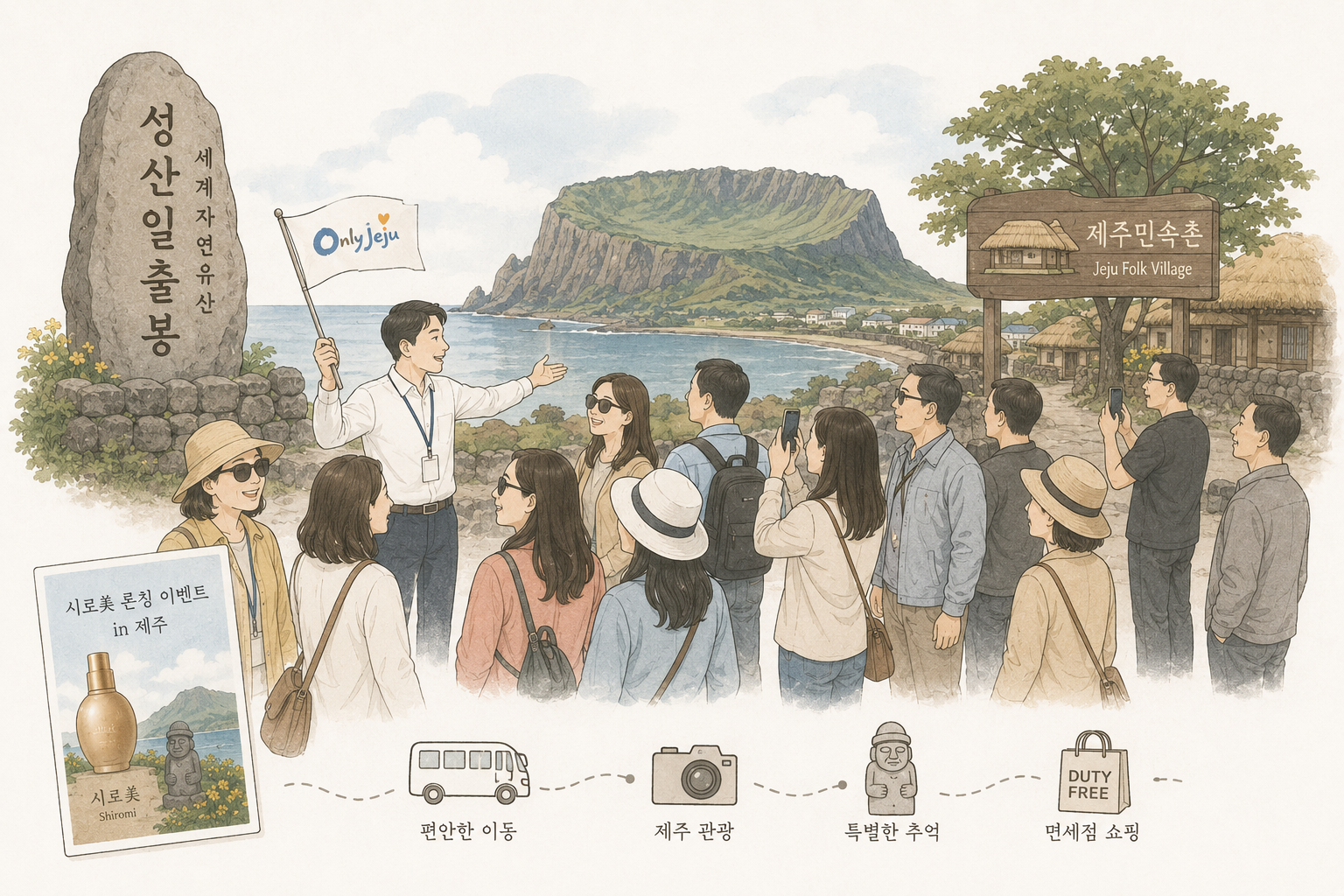
다음 날 나는 한국 법인 진행팀과 헤어져 여행 패키지에 합류했다. 성산 일출봉을 땀을 흘리며 오르다 보니 여기저기서 들리는 소리가 온통 중국어뿐이었다. 처음에 나는 우리가 데려온 일행들이 많기 때문이겠거니 하였지만, 알고 보니 우리 일행이 아닌 중국인들이었다.
민속촌에 가도 안내인들이 모두 중국어로 말했다. 언제부터 제주도가 이리 중국인들의 차지가 되었는지 놀라울 정도였다. 그러나 지금 제주도의 노른자위 땅들이 중국의 거대 자본에 넘어가고 있는 걸 보면, 나는 중국인들의 특별한 제주도 사랑이 그리 마땅치만은 않았다. 나는 중국에서 과거 우리나라의 1970년대처럼 개발이라는 명목 하에 아름다운 자연이 파헤쳐지고 사라지는 모습을 너무 많이 보고 있기 때문이다.
이는 물론 제주도가 아름다운 천혜의 자연을 가지고 있는 곳이기 때문만은 아니다. 사회주의 국가에서 자기 땅을 가지지 못하는 중국의 여건상, 돈 많은 중국인들이 미래를 대비하기 위하여 너 나 없이 해외에 땅을 사고 있기 때문이다.
거기에 부응하여 우리나라 정부는 제주도를 비자 없이도 입국이 가능한 자유 무역권으로 만들다 못해, 오십만 불, 약 오억 원만 투자해도 중국인에게 영주권을 주고 있는 실정이니, 더 이상 말을 해 뭐 하겠는가?
이러다 과거에 내가 봤던 조용하고 아름다우며 정감 넘쳤던 대한민국의 제주도는 다 사라지고, 마치 중국의 경제적 식민지로 전락한 일개 중국의 작은 성으로써, 산둥성 같은 중국 제주성이 탄생할지도 모르겠다는 걱정이 나의 뇌리를 스치고 지나갔다.
1박 2일 간의 아름다운 제주도 여행은 시로미와 관련된 서복기념관을 거쳐 마지막 면세점 쇼핑으로 끝났다. 매번 가는 곳마다 대단했던 중국인 사업자들의 바잉파워(Buying Power)는 마지막 종착지인 면세점에 도착하자 폭발하고 말았다.
어이없게도 우리와 거래하는 사업자들이 온통 한국의 다른 화장품을 사느라 혈안이었으나, 우리는 이를 제재할 수가 없었다. 그들은 분명 이렇게 한국에서 사간 화장품들을 중국에 가서 더 비싼 값으로 팔 테니, 이런 기회를 놓칠 이유가 없었을 것이다.
3박 4일간의 시로미 론칭 행사와 제주도 여행을 무사히 마친 우리는 제주도에 도착했을 때와 똑같은 방법으로 서울을 경유해서 중국으로 그들을 돌려보냈다.
단, 나와 리더급 대리상들 여섯 명은 서울에 남아서 서울 본사 방문을 시작으로 우리 제품이 입점되어 있는 워커힐 호텔의 면세점 방문 후 남산타워와 동대문 상가 등을 둘러보며 서울 여행을 하루 더 추가했다. 그들에게 실제로 한국 경제의 중심지인 강남에 있는 본사와 최고급 호텔 면세점에 입점한 회사의 위상을 보여 줌으로써, 자부심과 자신감을 고취하고 더욱 강한 신뢰를 쌓기 위함이었다.
워커힐 면세점에 갔을 때 대리상들은 서로 경쟁적으로 사진을 찍고 떠드느라 옆 매장에 방해가 되는 것도 아랑곳없이 소란을 피웠다. 그러자 결국 항의가 들어와 내가 자제를 요청하였으나, 그것도 잠시뿐이었다. 나는 참다못해 소란스런 그들 틈에서 빠져나와 면세점 입구로 걸어 나왔다.
문득 제주도에서 민 대표의 통역을 맡았고, 제주도 여행 때도 열심히 사업자들을 도와주느라 무척 애썼던 영업부 직원이 눈에 띄었다. 그녀는 매장 한 곳에 진열되어 있는 가방에서 눈을 떼지 못하고 서성이고 있었다. 나는 그녀에게 다가가 말을 걸었다.
“뭐 사고 싶은 게 있니?”
순간 그녀는 깜짝 놀라며 나에게 인사하며 머뭇거리듯 말했다.
“아니오, 가방이 너무 예쁜데, 비싸서요.”
그녀가 손으로 만지작거리고 있는 가방은 내가 봐도 귀엽고 예뻐 보였다. 명품은 아니었지만 외국에서 라이선스 된 젊은 층을 겨냥한 중가의 브랜드였는데, 원래 가격에서 50퍼센트 세일을 하고 있었다.
“지금 할인해서 많이 싸게 팔고 있는데, 이참에 하나 장만하지 그래? 여기까지 왔는데 말이야.”
“아니에요. 그래도 제겐 너무 비싸요.”
할인된 가격이 이십만 원 정도였으나, 그래도 그녀의 월급의 절반이나 되는 금액이었다. 못내 아쉬워하며 돌아서는 그녀를 보니 나는 그만 마음이 짠하여 그녀를 불러 세워 충동적으로 가방을 사주고 말았다.
“이건 이번 행사 때 일을 너무 잘해줘서 내가 선물로 주는 거야. 그러니 앞으로도 오래오래 회사에 남아서 열심히 일해줘. 알았지?”
“네? 진짜요? 총경리님, 너무 감사합니다.”
뛸 듯이 기뻐하는 그녀를 보며 나도 마음이 무척 흐뭇했다. 그런데 중국으로 복귀한 몇 달 후, 춘절 때 고향으로 돌아갔던 그녀는 연락도 없이 회사에 출근하지 않았다. 고향 친지의 소개로 다른 회사로 자리를 옮긴 것이다. 그때 나는 다시 한 번 깨달았다. 중국인 직원들에겐 특별히 더 마음을 쏟아서 개인적으로 잘해 줄 필요가 없다는 것을.
어차피 그들에겐 인간적인 마음보다 물질적인 조건이 더 중요한 게 현실이었다. 회사가 빨리 성장을 해서 이익을 실현하고 직원들에게 누가 넘볼 수 없는 급여와 복지 조건을 제공하지 못하는 한, 마음으로 잘해주려는 노력은 값싼 동정이자 자기 위로일 뿐이었다. 내가 진정한 경영자로 탈바꿈하기 위해서는 그들에게 미래의 비전과 함께 현실의 안정을 주는 것이 더 중요한 것이다.
나는 모든 행사를 무사히 끝내고 중국으로 돌아왔다. 제주도에는 함께 가지 못했지만, 중국에서 여러 모로 고생한 팀장들에게도 성공적인 행사에 대한 감사의 뜻을 표했다. 옛말에 ‘인심제, 태산이(人心齊, 泰山移)’란 말이 있다. 사람의 마음이 한데 모이면 태산도 옮길 수 있다는 뜻이다. 이런 성공적인 결과는 나 한 사람의 노력으로 된 것이 아니라, 모든 사람들의 정성이 함께하였기 때문에 가능한 일이었다.
The next day, I parted ways with the Korean branch event team and joined the travel package group. As I climbed Seongsan Ilchulbong, sweating under the sun, all I could hear from every direction was Chinese. At first, I assumed it was simply because our own group was so large, but I soon realized that many of them were unrelated Chinese tourists.
Even at the folk village, all the tour guides spoke Chinese. It was astonishing to see how completely Jeju Island had become filled with Chinese visitors. Yet seeing prime real estate throughout Jeju increasingly being acquired by massive Chinese capital investments, I could not entirely welcome this overwhelming affection that Chinese people had for Jeju. Having spent years in China, I had witnessed far too many beautiful natural environments being destroyed and erased in the name of “development,” much like what Korea experienced during the 1970s.
Of course, this phenomenon was not solely because Jeju possessed breathtaking natural beauty. In a socialist country where individuals cannot truly own land, wealthy Chinese citizens were purchasing overseas property everywhere they could in preparation for the future.
In response to this trend, the Korean government had not only turned Jeju into a visa-free free trade zone, but was even granting permanent residency to Chinese investors who invested merely 500,000 dollars—roughly 500 million Korean won. At that point, what more was there left to say?
A troubling thought suddenly crossed my mind. Perhaps one day, the quiet, beautiful, and warm-hearted Jeju Island I once knew would completely disappear, eventually reduced to little more than an economic colony of China—a small Chinese province, something akin to “Chinese Jeju Province,” much like Shandong Province.
The beautiful two-day, one-night journey through Jeju Island eventually came to an end after visiting the Xu Fu Memorial Hall related to Shiromi, followed by a final stop at a duty-free shopping center. Everywhere we went, the buying power of the Chinese distributors had already been remarkable, but once they arrived at the duty-free shop—the final destination of the trip—it exploded completely.
Ironically, the very distributors who were doing business with our company became obsessed with purchasing Korean cosmetics from competing brands. Yet there was little we could do to stop them. Clearly, they intended to return to China and resell those cosmetics at higher prices, so there was no reason for them to miss such an opportunity.
After successfully completing the four-day, three-night Shiromi launching event and Jeju Island tour, we sent all participants back to China through Seoul using the same travel route by which they had arrived.
However, six top-level distributors and I remained in Seoul for an additional day. Beginning with a visit to our headquarters in Seoul, we toured the duty-free store at the Walkerhill Hotel where our products were displayed, followed by sightseeing at Namsan Tower and the Dongdaemun shopping district. By showing them the headquarters located in Gangnam—the very center of Korea’s economy—as well as our presence inside one of Korea’s most luxurious hotel duty-free shops, I hoped to inspire pride, confidence, and even stronger trust in the company.
When we visited the Walkerhill duty-free shop, the distributors became so excited that they loudly took photographs and chattered among themselves competitively, completely ignoring the fact that they were disturbing neighboring stores. Eventually, complaints were made, and I had to ask them to calm down, though it lasted only briefly. Unable to tolerate the commotion any longer, I slipped away from the noisy crowd and walked toward the entrance of the duty-free shop.
At that moment, I noticed one of the sales department employees who had served as CEO Min’s interpreter during the Jeju event and had worked tirelessly helping the distributors throughout the trip. She stood lingering in front of a display case, unable to take her eyes off a handbag.
I approached her and asked,
“Is there something you want to buy?”
Startled, she quickly greeted me and replied hesitantly,
“No… the bag is just so pretty, but it’s too expensive.”
Even to me, the handbag looked elegant and charming. It was not a luxury brand, but rather a mid-range international licensed brand aimed at younger consumers, currently being sold at a fifty percent discount.
“They’re selling it much cheaper right now because of the sale. Since you’re already here, why not buy one?”
“No, it’s still far too expensive for me.”
Even after the discount, the bag still cost around 200,000 Korean won—roughly half of her monthly salary. Watching her reluctantly turn away from it, I suddenly felt a sharp pang in my heart. Without thinking, I called her back and impulsively bought the handbag for her.
“This is a gift from me because you worked so hard during this event. So stay with the company for a long time and continue working hard for us, alright?”
“What? Really? General Manager, thank you so much.”
Seeing her practically jump with joy filled me with genuine satisfaction as well.
Yet only a few months after we returned to China, during the Lunar New Year holiday, she went back to her hometown and never returned to work. Without even notifying the company, she transferred to another firm through the introduction of relatives back home.
At that moment, I realized something once again. There was no need to become overly emotionally invested in Chinese employees on a personal level.
In reality, material conditions mattered far more to them than emotional bonds. Unless the company could grow rapidly, generate substantial profits, and provide salaries and welfare benefits that no competitor could rival, efforts to treat employees warmly from the heart alone were ultimately nothing more than cheap sympathy and self-consolation.
If I truly wanted to transform myself into a genuine manager, what mattered most was not emotional generosity, but providing employees with both a vision for the future and tangible stability in the present.
After successfully completing all the events, I returned to China. Although they had been unable to accompany us to Jeju Island, I also expressed my gratitude to the team leaders in China who had worked tirelessly behind the scenes throughout the entire process. There is an old saying: “When people unite their hearts, even Mount Tai can be moved” (人心齊, 泰山移). Such a successful outcome was never the result of my efforts alone, but was only possible because everyone contributed their dedication and sincerity together.